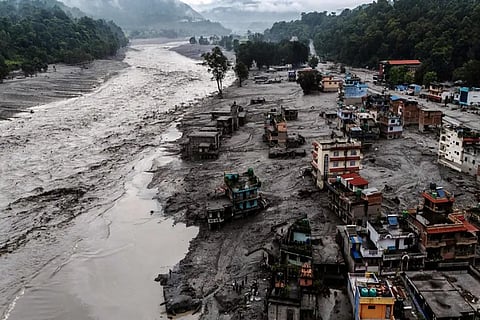

Nepal government has formed a seven-member expert panel to investigate what triggered last month’s devastating floods, which killed more than 1,400 people and left over 6,000 missing, an official said on Saturday.
The panel would also examine the possible role of climate change in the disaster.
Flash floods originating near the Nepal-Tibet border on August 26 devastated towns and villages in northern and central Nepal. The Bhotekoshi River, which flows south from the Himalayan border region, carried the floodwaters downstream, sweeping away homes, vehicles, roads and bridges and damaging hydropower projects.
The Ministry of Energy, Water Resources and Irrigation has formed the panel comprising experts in hydrology, glaciology, remote sensing, geology, hydropower infrastructure and disaster risk reduction, according to Tika Ram Baral, joint secretary-rank officer at the ministry.
The panel, headed by water policy and governance expert Debesh Belbase, comprises hydrologist Narendra Man Shakya, glaciologist Rijan Bhakta Kayastha, remote-sensing expert Uttam Babu Shrestha, hydropower infrastructure expert Hari Pandit, geologist Meghraj Dhital and disaster-risk reduction specialist Anil Pokhrel.
The panel will seek to determine what exactly caused the devastating flash flood in the Bhotekoshi river on August 26, how the disaster unfolded and whether climate change played a role, Baral said.
There had been speculation that the flood was triggered by a collapse of ice and rock in the high Himalayas, followed by an avalanche. However, a preliminary assessment has found insufficient scientific evidence to conclusively establish the origin and sequence of the disaster.
The expert panel will conduct a detailed scientific investigation to establish the cause and sequence of events and examine the possible links among glacial, geological and hydrological hazards.
The panel has been asked to submit a preliminary report within a month, said Baral. If necessary, it may also recommend a more detailed scientific study of the disaster.
Days after the flash floods, the US Geological Survey (USGS) had said they were triggered by a glacial collapse. It said that additional analysis of the long-period seismic waves indicated that the tremors were generated by a glacial collapse and debris flow.
Earlier this month, Chinese authorities stated that the flash floods along the Tibet-Nepal border were triggered by a high-altitude glacier collapse in Nepal.